
Welfare & Contemporary African Art Workshop

On Wednesday, 15 July 2026, we held the 'Welfare × Contemporary African Art Workshop' in Izunokuni City, Shizuoka, Japan.
The Amamoto & Shiraishi Africulture Centre is proud to have organised this project, with support from the Arts Council Shizuoka. A total of 17 participants from three Type B Continuous Employment Support Offices in Izunokuni City (Mokusei-en, Blue Beat and Miraika Nirayama) cooperated in the project. Furthermore, the event was attended by 20 observers, fostering a conducive environment for knowledge-sharing among a diverse group of participants, including representatives of cultural and arts promotion organisations, as well as local government officials responsible for disability welfare.
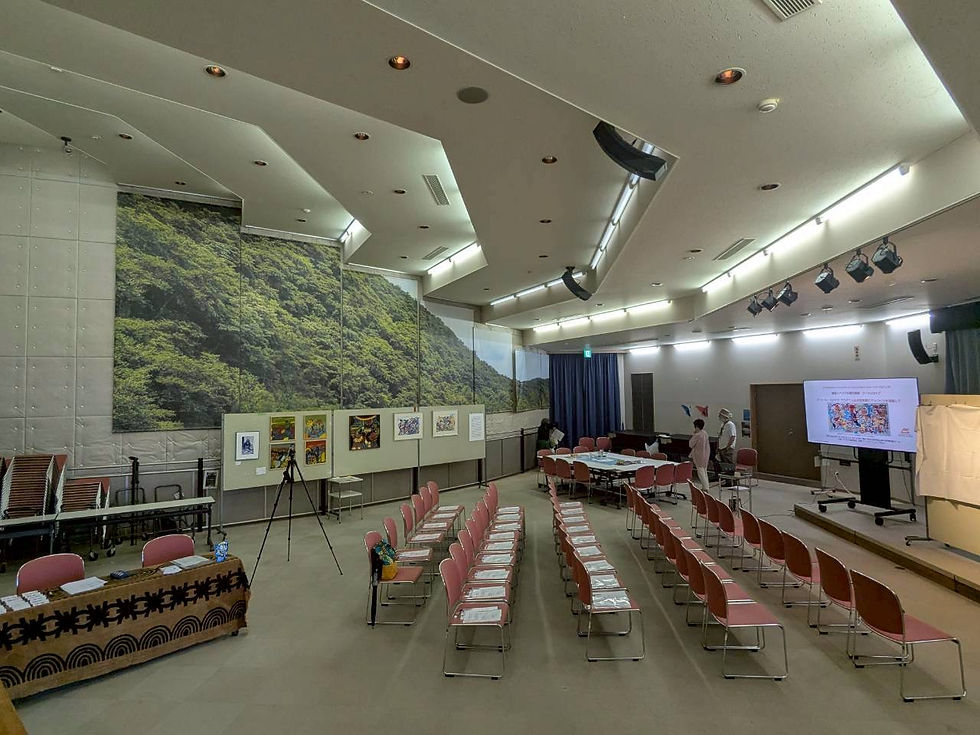
This year, in addition to an interactive art appreciation session on contemporary African art, facility staff experienced facilitation, followed by a discussion involving facility directors, staff and facilitators. Concurrently, 11 service users participated in creative activities, each allocating their time as they saw fit.
The workshop commenced with an introduction to the works of the late Teruo Honda, a local Chorogeijutu (Art of the Aged, Arts Council Shizuoka) artist. This was followed by an interactive art appreciation session focusing on George Lilanga's Shetani (1998, copper canvas, enamel paint).
The facilitation experience that followed was based on five themes: 'colour', 'motif', 'place', 'sound and movement', and 'the viewer's feelings'. Five members of staff from the facility participated in the facilitation process. Despite the inexperience of many of the participants, they skilfully facilitated constructive dialogue among the audience members.
On this occasion, I was particularly struck by the parallels drawn by the staff members between the figures depicted in Shetani and their own work in the welfare sector.
"In the social care sector, we are all interconnected and support each other, as illustrated in this painting."
"The artwork itself served as a medium for reflecting on the connections between people."
Upon hearing such comments, it became evident once again that this work is not merely an object of appreciation, but rather a medium through which mutual understanding and connection can be fostered among individuals within the social care setting.
Furthermore, we heard comments such as, 'For the first time, I saw a service user who doesn't usually speak up in a group actually speaking out in this setting,' and 'I was once again impressed by the immense power of art.' Instead of interacting with each person directly, the use of a single artwork establishes an environment in which individuals feel at ease expressing their thoughts and feelings. I sensed great potential in this as a gateway to communication.
One of the workshop's key accomplishments was the valuable opportunity it provided to hear directly from the facility directors. We plan to include participants' feedback in the report leaflet that we will be producing.
Finally, I would like to express my heartfelt gratitude to Ms Kana Higuchi of Arts Council Shizuoka, who worked closely with us from the planning stage, keeping an eye on the overall picture and providing support at key moments. I would also like to thank Ms Sayori Amano for her constant and warm support.
I would like to extend my sincere gratitude to all participants and observers.
The workshop was also featured in the Izu Nichinichi Shimbun and the Shizuoka Shimbun.


Comments